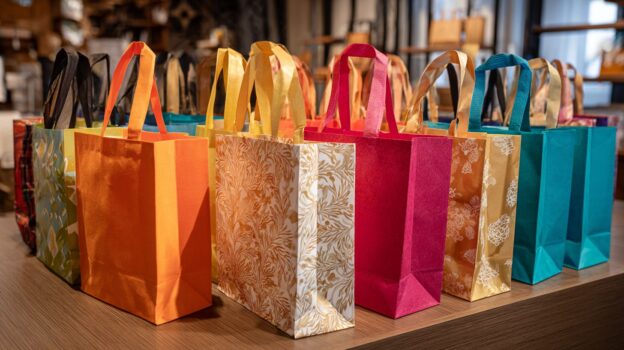
In a retail landscape where first impressions drive loyalty, a well-customized shopping bag can transform a simple purchase into a memorable brand encounter. As consumers increasingly prioritize sustainability and personalization-backed by Nielsen’s findings that 78% favor eco-conscious packaging-choosing the right options is crucial for standing out. Discover top material selections like paper and reusable fabrics, innovative printing methods, structural designs, and eco-features that balance cost, creativity, and impact.
Key Material Options
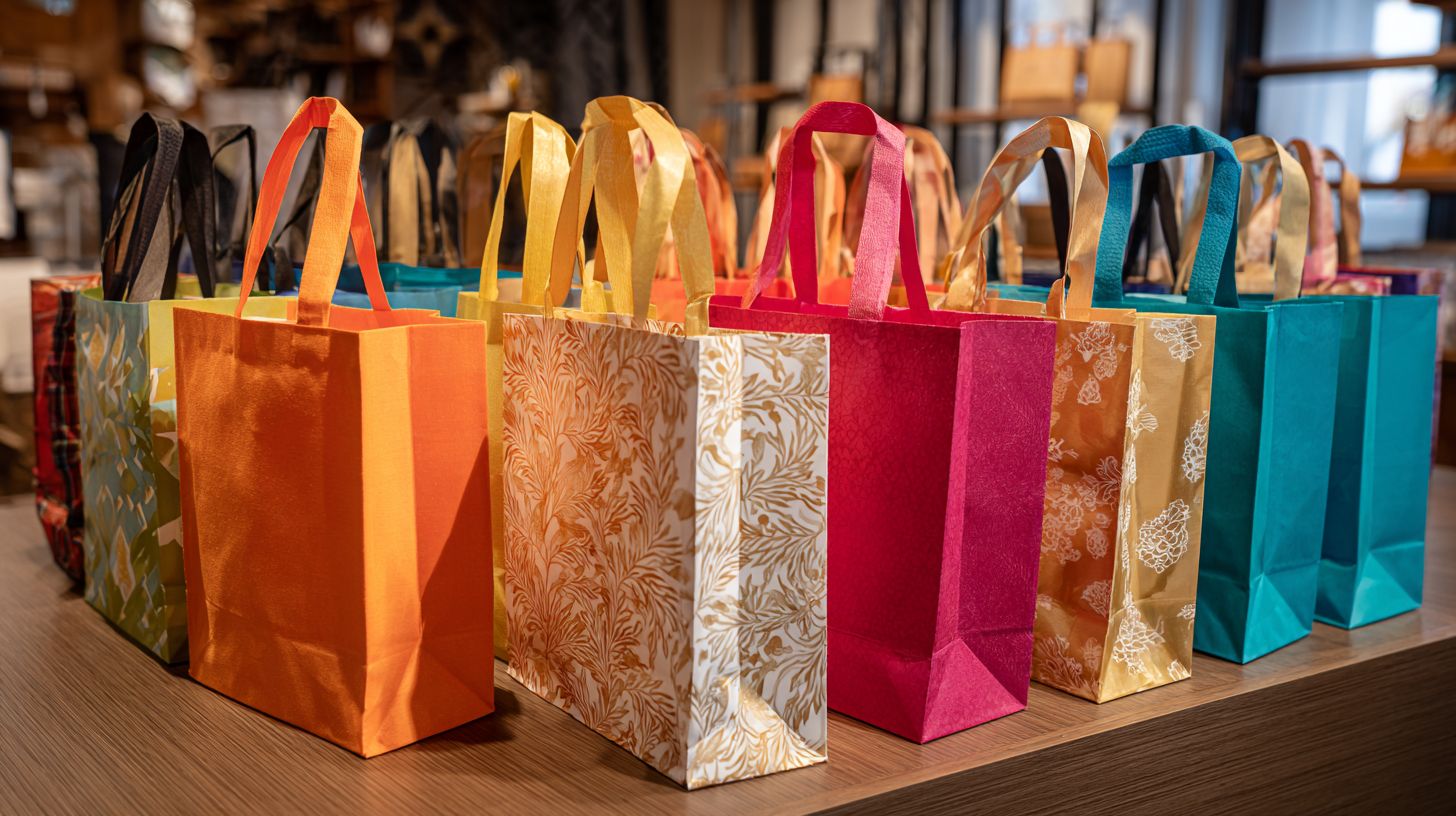
Choosing the appropriate material for custom shopping bags necessitates a careful balance of durability, cost, and sustainability. Paper options hold a 45% market share, primarily due to their environmental appeal, according to data from the EU Packaging Directive 2023.
Paper-Based Bags
Paper-based bags, typically constructed from 100-200 GSM kraft stock, represent a premium and recyclable alternative suitable for retail applications, capable of supporting up to 20 pounds, as demonstrated by Starbucks’ branded carriers.
These bags provide several advantages, including biodegradability within 3-6 months in accordance with ASTM D6400 standards and customization options such as foil stamping for branding purposes.
A primary limitation is their reduced durability in wet conditions, which may necessitate the application of water-resistant coatings for outdoor applications.
For selection purposes, please refer to the comparison of options below:
| Type | GSM | Cost/Bag | Best For | Examples |
|---|---|---|---|---|
| Kraft | 120 | $0.15 | Grocery | Basic carryout |
| Coated | 150 | $0.25 | Luxury retail | Branded gift bags |
Whole Foods’ transition to 100% recycled paper bags achieved an 80% reduction in plastic usage, as reported in their 2022 sustainability report.
Bulk sourcing is available from Uline for orders starting at 1,000 units.
Plastic and Poly Bags
Plastic and polyethylene bags offer waterproof durability for loads up to 50 pounds, with polyethylene variants accounting for 30% of e-commerce packaging according to a 2022 study by the Freedonia Group.
The primary types include high-density polyethylene (HDPE), which costs approximately $0.05 per bag and provides robust, reusable totes suitable for bulk shipping, and low-density polyethylene (LDPE), priced at about $0.08 per bag and offering flexible options ideal for grocery-style packaging.
Advantages of these bags include resistance to moisture for weatherproofing and ease of folding for convenient storage. However, drawbacks encompass significant environmental concerns, including bans in more than 150 countries as part of draft United Nations plastic treaties.
It is noteworthy that FDA-approved variants ensure suitability for food-contact applications. For example, Amazon’s 10-mil thick poly mailers effectively safeguard items such as books during transit.
Customization is available through platforms like BagMaven, with a minimum order quantity of 500 units recommended to optimize costs.
Fabric and Reusable Materials
Fabric and reusable bags, such as 10-oz canvas totes, offer exceptional longevity with over 100 uses per bag, thereby supporting compliance with the European Union’s single-use plastic ban implemented in 2021.
To identify the most suitable options, it is advisable to evaluate the following widely utilized materials:
- Organic cotton totes ($1.50 per bag, 15 lbs capacity): These are robust and environmentally sustainable, making them particularly appropriate for transporting heavy items.
- Non-woven polypropylene bags ($0.40 per bag): These lightweight options are well-suited for promotional purposes and can withstand up to 50 uses.
The advantages of custom printed reusable bags encompass their washability and the potential for branded embroidery to enhance marketing efforts; however, a notable drawback is the elevated initial investment required. According to a report by the UK’s Waste & Resources Action Programme (WRAP), reusable bags can reduce carbon footprints by 80% within a single year.
For instance, Trader Joe’s cotton totes incorporate reinforced bottoms capable of supporting loads of up to 20 lbs. To develop your product line effectively, utilize Adobe Illustrator for pattern design and procure wholesale supplies from Alibaba, where the minimum order quantity (MOQ) is typically 1,000 units.
Printing and Design Techniques
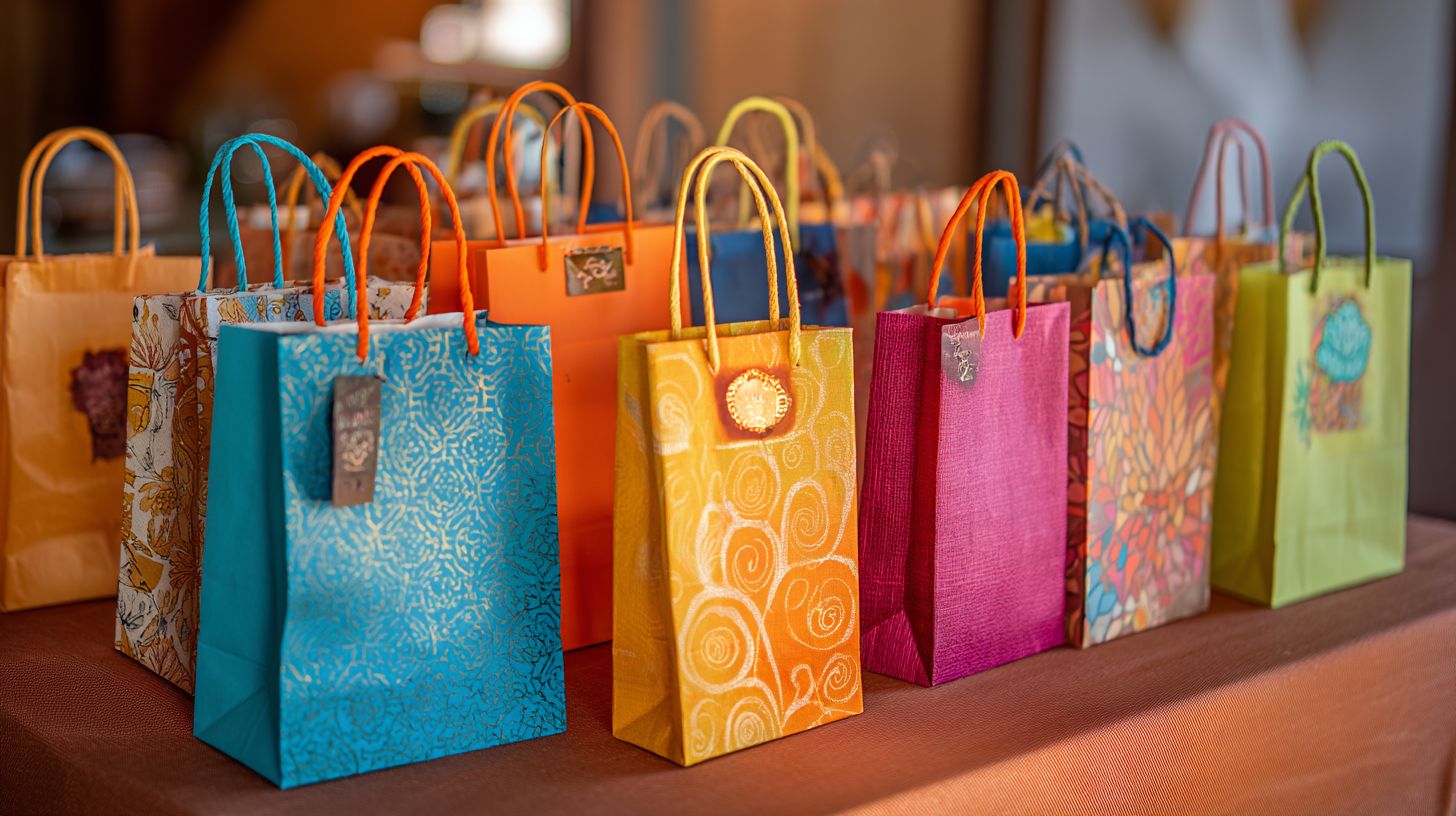
Utilizing effective printing techniques transforms custom shopping bags from mere functional items into valuable marketing assets. Screen printing, valued for its exceptional durability, accounts for 60% of branded bag production, according to data from the Printing Industries of America (2023).
Screen Printing
Screen printing employs a stencil-based method of ink application, yielding vibrant and fade-resistant results on bags. This technique is particularly suitable for production runs exceeding 1,000 units, with costs ranging from $0.20 to $0.50 per impression.
To initiate the process, adhere to the following step-by-step procedure:
- Prepare the artwork in Adobe Illustrator (.ai) format to facilitate precise vector scaling.
- Produce emulsion-coated screens, priced at $50-$100 each, with one screen required per color.
- Apply 1-4 colors utilizing water-based inks and a squeegee to achieve uniform coverage.
- Cure the prints in a conveyor dryer at 300 degreesF for 1-2 minutes.
For smaller production batches, consider utilizing cost-effective Speedball kits, available for $30-$50.
- Advantages encompass exceptional durability, enduring over 50 washes; disadvantages include a setup time of 2-3 days.
For instance, Nike’s eco-tote bags incorporate two-color screen prints.
A comprehensive cost analysis reveals: $500-$1,000 for setup, plus $0.30 per impression.
Refer to ASTM D543 for standardized ink adhesion testing to uphold quality in accordance with industry benchmarks.
Digital and Flexographic Printing
Digital printing facilitates the production of full-color, variable designs on demand, making it ideal for small runs of fewer than 500 bags. In contrast, flexographic printing is optimized for high-volume production, achieving speeds of up to 2,000 feet per minute.
For optimal cost efficiency, digital inkjet printing typically averages $0.30 per bag, requiring no plates and offering seamless integration with tools such as Canva for rapid design creation. Flexographic printing, which employs rotary presses and eco-solvent inks, reduces costs to $0.10 per bag for runs exceeding 10,000 units while ensuring compliance with FDA regulations for food-contact packaging under 21 CFR 176.170.
Production turnaround times are notably shorter for digital methods, at 1-2 days, compared to 5-7 days for flexographic processes.
The following table summarizes the advantages and disadvantages of each method:
| Method | Pros | Cons |
|---|---|---|
| Digital | Variable data capabilities, low setup costs, ideal for custom orders | Higher per-unit costs for large volumes |
| Flexo | Low costs at scale, durable inks | High setup fees, limited flexibility for modifications |
The digital printing process involves the following steps:
- Upload a PDF/X-1a file.
- Approve a CMYK color proof.
- Print, cut, and laminate the product.
Etsy sellers frequently utilize Printful’s digital printing services for personalized tote bags, enabling seamless scaling from prototypes to orders of up to 100 units.
Size, Shape, and Structural Choices
Tailoring the size and shape of packaging to specific product requirements-such as 12×16-inch grocery bags featuring 4-inch gussets-improves both functionality and branding opportunities. According to a 2022 Packaging Digest survey, custom die-cuts can increase perceived value by 20 percent.
- Standard sizes encompass small (8×10 inches, suitable for gifts at $0.20 per bag), medium (12×15 inches, designed for retail applications and capable of holding up to 15 pounds), and large (16×20 inches, ideal for totes supporting up to 30 pounds).
To enhance structural integrity, incorporate gussets ranging from 2 to 6 inches for expandable capacity or die-cut windows to facilitate product visibility.
Utilize Packsize software to develop custom templates, leveraging its intuitive drag-and-drop interface for precise dimension visualization. For instance, Sephora’s 10×12-inch pouches equipped with euro slots demonstrate effective retail design principles.
- Recommended best practices include aligning sizes with intended items, such as 14×18-inch bags for wine bottles;
- implementing minimum order quantities of 500 units for custom shapes;
- and adhering to ISO 8317 standards for child-resistant and tamper-evident features to guarantee compliance and safety.
Handles, Closures, and Add-Ons
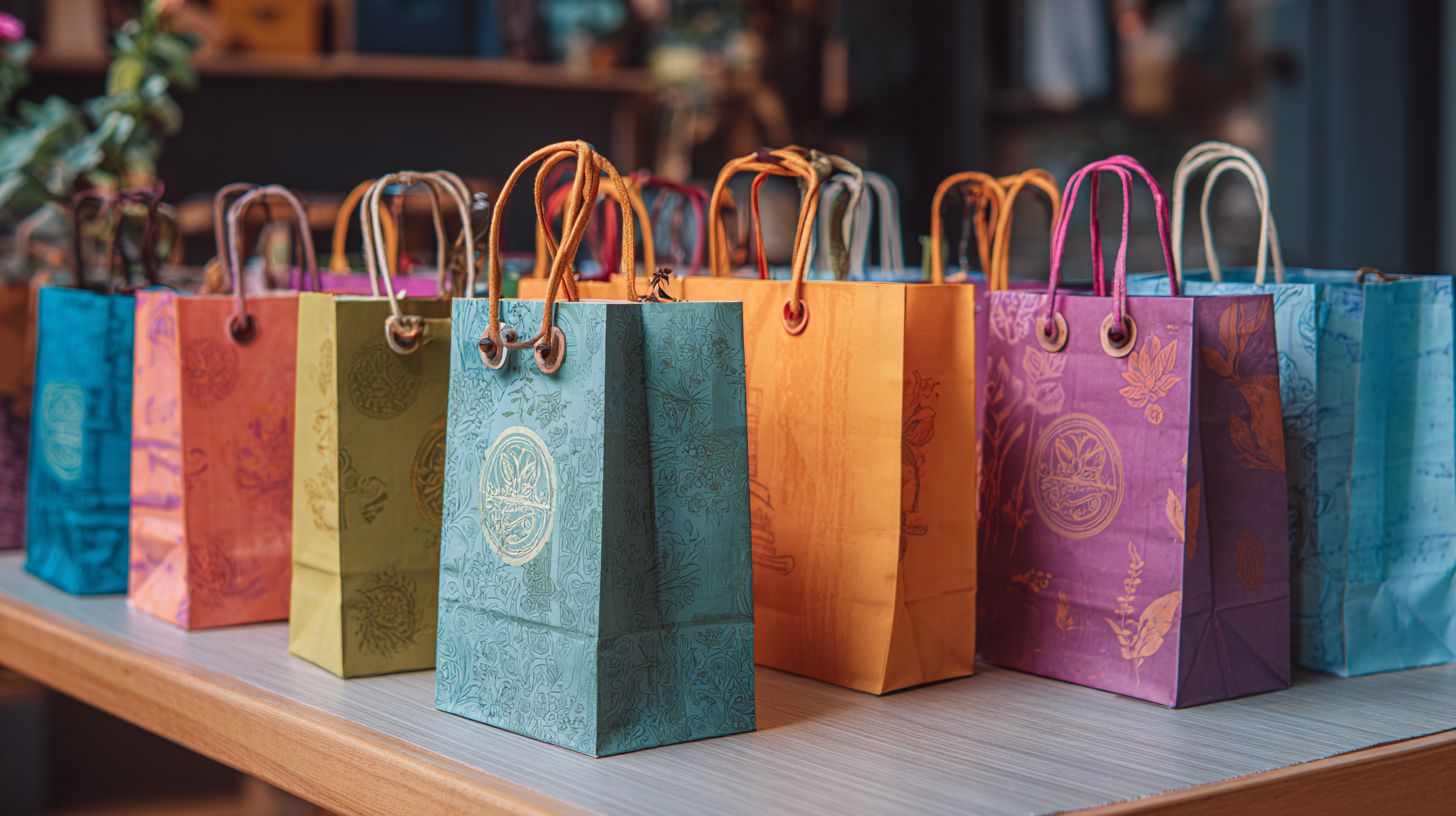
Handles and closures, such as twisted paper ropes with a 100-pound strength rating, not only enhance usability but also improve tactile appeal. According to a 2023 Mintel consumer study, 65% of shoppers prefer reinforced options.
To optimize bag design, categorize handles by material and cost. Twisted paper ropes, priced at $0.05 per unit, provide durability for loads up to 100 pounds and are ideal for eco-friendly totes. In contrast, flat handles, at $0.03 per unit, offer lightweight appeal suitable for casual applications.
For closures, zippers, costing $0.50 each, provide secure fastening for high-value bags, while drawstrings, at $0.10 per unit, deliver a relaxed aesthetic appropriate for gym or active use, as exemplified by Lululemon’s rope-handle designs.
Enhance functionality with add-ons such as woven labels ($0.15 per unit) or 2-ply cardstock bottoms for added reinforcement. The setup process includes:
- selecting handle lengths (8-24 inches) based on bag dimensions;
- attaching via industrial glue or stitching using equipment like Brother sewing machines; and
- testing under ASTM F963 standards to prevent failures under heavy loads.
This methodology effectively balances functionality with consumer preferences.
Eco-Friendly and Sustainable Features
Incorporating eco-friendly features, such as 100% recycled polyester, can reduce the environmental impact by 50% over the lifecycle of each bag, according to the 2022 Ellen MacArthur Foundation report on circular economy principles.
To maximize these benefits, it is advisable to select materials like jute, which biodegrades within six months and costs approximately $0.80 per bag. These should be paired with soy-based inks that are free of volatile organic compounds (VOCs) and compliant with EU REACH standards.
Additionally, pursue relevant certifications, including FSC for paper components and GOTS for organic fabrics.
For reusable products, note that they can reduce waste by one ton annually for every 10,000 bags, based on Environmental Protection Agency (EPA) data.
Adhere to the following best practices:
- Source materials from reputable suppliers such as NoIssue.
- Embed QR codes to provide clear recycling instructions.
- Evaluate the carbon footprint using tools like CarbonCloud.
Ensure compliance with applicable regulations, including California’s SB 54 plastic bag ban.
For instance, Patagonia’s tote bags incorporate 92% post-consumer content, exemplifying superior sustainability practices.
Branding and Personalization Strategies
Implementing strategic branding on shopping bags, such as the use of Pantone-matched logos, can enhance brand visibility by 40% through word-of-mouth promotion, according to a 2023 study published in the Journal of Marketing on the efficacy of tactile advertising.
To optimize this advantage, the following three key strategies are recommended:
- Position the logo centrally at a size of 4×4 inches to ensure prominent visibility without overwhelming the overall design of the bag.
- Select color schemes that integrate primary brand colors with subtle accent hues to evoke targeted emotions; for instance, vibrant reds to convey energy.
- Personalize the bags via variable data printing to incorporate names or custom messages, incurring an additional cost of only $0.10 per item.
In addition, consider the following approaches:
- Employ design tools such as Canva Pro (available for $12.99 per month) or Vistaprint’s online customizer.
- Draw inspiration from established examples, including Coca-Cola’s festive red holiday bags or IKEA’s minimalist white totes.
- Measure return on investment by implementing unique hashtags, such as #MyBrandBag, which have been shown to yield a 20% increase in engagement.
- Integrate augmented reality (AR) QR codes to enable interactive unboxing experiences, effectively bridging physical and digital elements.
Cost Factors and Best Practices
The costs associated with custom bags vary significantly, ranging from $0.10 for basic polyethylene options to $3.00 for embroidered luxury variants. Bulk orders of 5,000 units or more can reduce prices by up to 40% through economies of scale, as indicated by 2023 data from Alibaba suppliers.
Key cost components include materials, which comprise approximately 40% of the total (for example, cotton at $0.20 per unit compared to canvas at $0.80 per unit), printing at 30% (with screen printing versus digital methods costing $0.15 to $0.50 per bag), minimum order quantities (MOQ) ranging from 100 to 10,000 units, and shipping fees of $0.05 to $0.20 per bag.
To optimize expenses, implement the following best practices:
- Negotiate terms with suppliers such as Printify, which provides a 7- to 14-day turnaround;
- Adopt Acceptable Quality Limit (AQL) standards to maintain defect rates at 2.5%;
- Schedule orders seasonally to achieve 20% cost savings.
Employ Microsoft Excel for developing cost calculators and Google Forms for conducting feedback surveys.
In terms of return on investment (ROI), Brand X’s production of 10,000 tote bags at $0.50 each generated $5,000 in loyalty program sales. Similarly, a small retailer realized 25% savings by utilizing digital printing for production runs of 1,000 bags.
Frequently Asked Questions
What Are the Best Customization Options for Shopping Bags?
The best customization options for shopping bags include printing techniques like screen printing for vibrant colors and durability, digital printing for complex designs, and embroidery for a premium tactile feel. Additionally, options such as adding custom handles, eco-friendly materials like recycled paper or cotton, foil stamping for metallic accents, and personalized tags allow brands to create unique, memorable packaging that enhances customer experience.
What materials work best for customizing shopping bags?
For customizing shopping bags, paper and kraft options are ideal for lightweight, recyclable designs, while canvas or non-woven polypropylene suits reusable bags with high durability. What Are the Best Customization Options for Shopping Bags? Incorporating these materials allows for easy printing, dyeing, or stamping to match brand aesthetics without compromising on strength or sustainability.
How can I incorporate branding into shopping bag customization?
Branding can be incorporated through logo placement via heat transfer or UV printing for sharp images, custom color matching to align with your palette, and adding QR codes or social media handles. What Are the Best Customization Options for Shopping Bags? These methods ensure your brand stands out, fostering loyalty and turning everyday bags into marketing tools.
Are there eco-friendly customization options for shopping bags?
Yes, eco-friendly options include using biodegradable inks, organic cotton fabrics, and soy-based adhesives for printing. What Are the Best Customization Options for Shopping Bags? Opting for FSC-certified paper or reusable tote styles with minimalistic designs reduces environmental impact while appealing to conscious consumers seeking sustainable packaging.
What printing techniques are recommended for shopping bag customization?
Recommended techniques are flexographic printing for large runs with cost efficiency, sublimation for all-over patterns on synthetic bags, and debossing for subtle, elegant textures. What Are the Best Customization Options for Shopping Bags? Choosing the right method depends on design complexity, quantity, and desired finish to achieve professional results.
How do I select sizes and shapes for customized shopping bags?
Select sizes based on product needs-small for retail items, large for groceries-and shapes like flat-bottom or gusseted for stability. What Are the Best Customization Options for Shopping Bags? Customization allows tailoring dimensions with reinforced bottoms or foldable designs, ensuring functionality and a polished, brand-specific look.
Ready to turn your shopping bags into a powerful branding tool? At aplasticbag.com, we make it easy to customize shopping bags that reflect your brand’s style, values, and quality. Choose from a wide range of materials, sizes, colors, and printing options to create bags that truly stand out and leave a lasting impression on your customers. Whether you need eco-friendly paper bags, durable plastic bags, or premium retail packaging, we deliver quality you can trust—on time and within budget.
Order now and give your business the custom shopping bags it deserves to boost visibility, enhance customer experience, and drive repeat sales.

 What Are the Benefits of Choosing Retail Shopping Bags Wholesale for Growing Businesses?
  12 Benefits When You Order Custom Plastic Shopping Bags for Your Business
  Why Should Retailers Invest in Promotional Shopping Bags With Logo?
Comments