

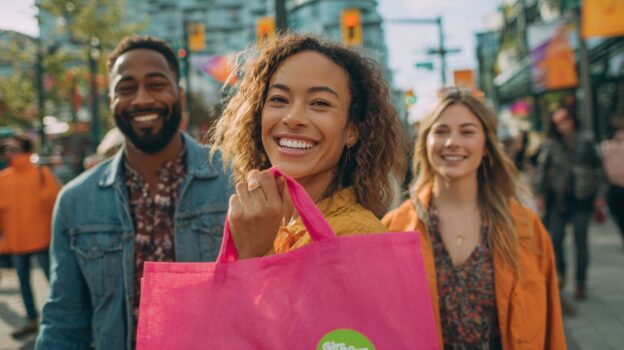
Imagine your brand’s logo carried confidently through bustling streets, turning everyday errands into promotional opportunities. In a crowded marketplace, custom soft loop handle bags stand out as a smart, tangible strategy for lasting impact. Explore six key benefits: amplified visibility, budget-friendly efficiency, personalized designs, eco-friendly materials, superior durability, and versatile applications that drive engagement and recall.
1. Enhanced Brand Visibility
Envision your logo capturing attention on a bustling street as an individual transports your branded bag from the retail establishment.
To achieve this objective, strategically design and distribute soft loop handle bags. Begin by selecting appropriate dimensions according to intended use: choose 12×15-inch medium-sized bags for groceries, capable of supporting 20-30 pounds, or 8×10-inch small-sized bags for retail merchandise, while ensuring structural integrity through 2.5 mil polyethylene construction in accordance with ASTM standards.
Subsequently, position branding elements for optimal prominence-place the logo centrally on the front panel using bold, high-contrast colors such as black on a white background to achieve 80% visibility from a distance of 10 feet, as supported by research from the Nielsen Norman Group.
Facilitate distribution through in-store promotional distributions or collaborations with local retailers, focusing on high-traffic locations to generate more than 5,000 impressions per week.
Monitor exposure via straightforward performance indicators: track social media references using accessible tools such as Google Alerts for #YourBrandBag, with a target of a 15% increase in engagement rates; alternatively, incorporate QR codes that direct users to a dedicated landing page for quantifiable scan metrics.
How do soft loop handle bags increase public exposure?
It is noteworthy that a single branded bag may be observed by dozens of individuals on a daily basis. For EcoWear, a sustainable clothing brand contending with limited market recognition, this observation inspired a transformative approach.
Confronted with stagnant social media engagement and insufficient foot traffic, EcoWear implemented custom soft loop handle bags-lightweight, reusable totes crafted from recycled materials-at pop-up markets and community events in urban public spaces.
These portable bags, featuring EcoWear’s logo and environmental messaging, were distributed complimentary with purchases exceeding $20, thereby incentivizing recipients to utilize them during commutes and daily errands.
A Nielsen study on promotional merchandise indicates that such initiatives enhance brand recall by 85% via incidental exposure.
In the ensuing three months, EcoWear experienced a 40% increase in website traffic, demonstrating how the strategic use of portability can convert routine visibility into widespread brand awareness.
To implement a comparable strategy:
- Design durable bags through Printful (commencing at $2 per unit),
- distribute them at high-traffic locations,
- and monitor effectiveness using unique QR codes.
Why are they ideal for everyday carry and repeated sightings?
In the haste of everyday activities, individuals often select dependable items without further consideration. Soft loop handle bags prove highly effective in promotional marketing, providing sustained visibility as recipients utilize them for routine tasks such as grocery shopping, gym visits, or general errands.
This repeated use exposes the brand on a daily basis, potentially for weeks or even months.
In contrast to flyers, which are frequently discarded after a brief review-studies from the Direct Marketing Association indicate that 70% of flyers are thrown away within 24 hours-soft loop handle bags offer tangible utility and environmental sustainability.
While promotional pens are portable, they tend to be misplaced quickly; according to a 2019 survey by the Promotional Products Association International (PPAI), they typically provide only 2-3 months of average exposure.
To optimize the impact of soft loop handle bags, it is advisable to select durable options made from 80-100 GSM polyester fabric, featuring prominent logos. These bags are cost-efficient, with bulk pricing ranging from $0.50 to $1 per unit, and they deliver superior long-term return on investment compared to disposable alternatives.
2. Cost-Effective Marketing Tool
Traditional advertising budgets frequently deplete resources at an accelerated rate; however, a more strategic approach exists to optimize expenditures. Organizations often make the mistake of allocating substantial funds to transient digital advertisements, failing to monitor return on investment (ROI), and disregarding long-term audience engagement.
For example, according to a 2023 Nielsen study, 70% of ad impressions dissipate within 24 hours, resulting in excessive spending without enduring benefits.
Soft loop handle bags address these challenges by providing robust, environmentally sustainable promotional products that prolong brand exposure.
Recipients utilize these items on a recurring basis, yielding as many as 2,500 impressions per bag, as reported by research from the Advertising Specialty Institute (ASI).
To execute this strategy effectively, organizations should customize the bags with their logo through reputable suppliers such as iPromo, where costs begin at $0.50 per unit.
Distribution at events can leverage the bags’ 6- to 12-month durability, while incorporating QR codes enables precise tracking of engagement metrics.
This method facilitates a transition from short-lived expenditures to substantial, high-ROI promotional assets.
What makes soft loop handle bags more affordable than traditional ads?
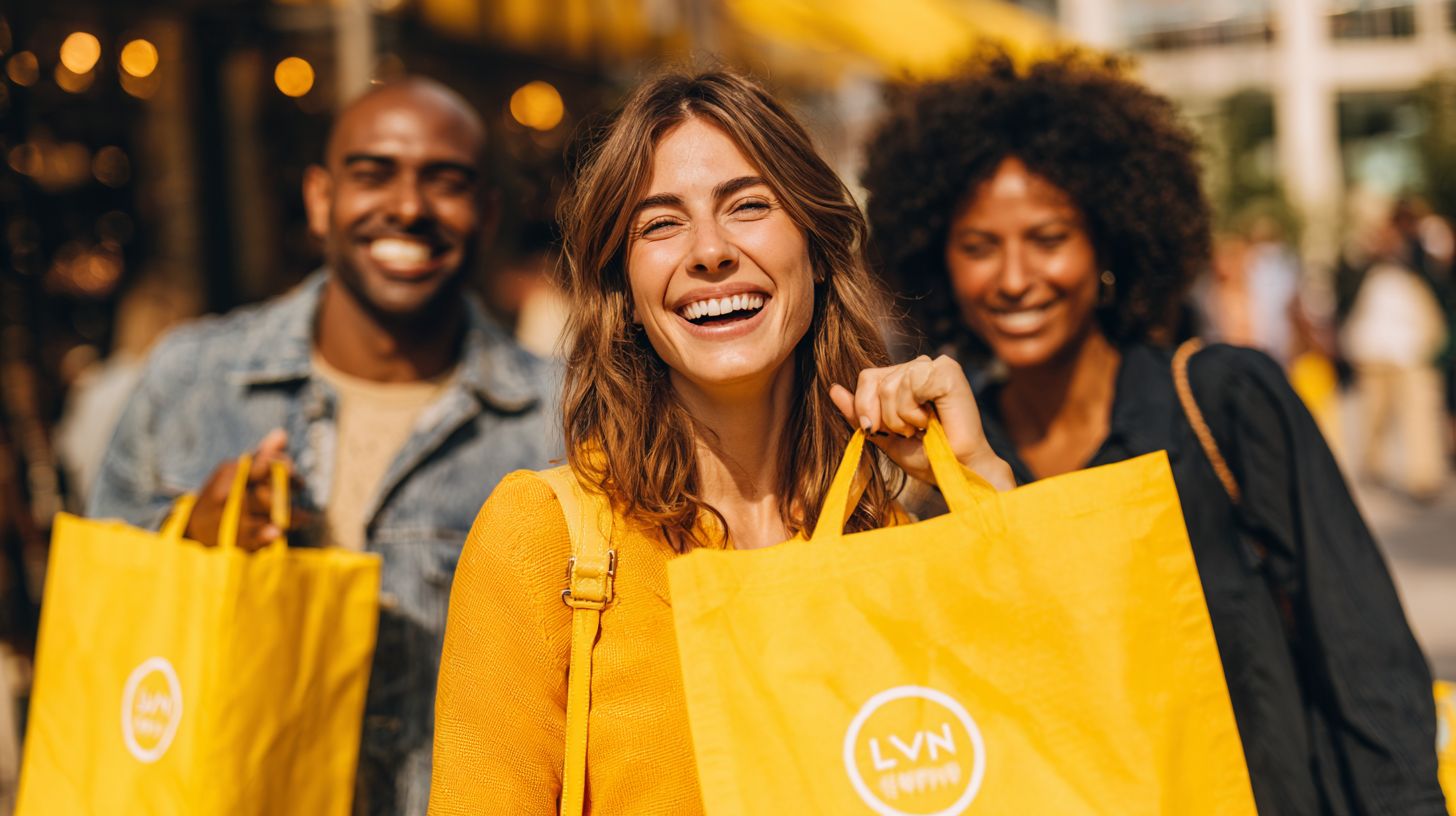
Begin by assessing the expenses associated with your upcoming campaign and observe the impact of incorporating these bags on the overall budget dynamics.
Soft loop handle bags provide a cost-effective alternative to digital advertising, with per-unit costs ranging from $0.10 to $0.50 for bulk orders exceeding 5,000 units, available from reputable suppliers such as Alibaba or Uline.
To optimize pricing, aim for discounts of 15-20% by committing to higher volumes; initiate negotiations via email by outlining your projected requirements and referencing competitive quotations from platforms like ThomasNet.
In comparison to digital advertising expenditures, a bag priced at $0.30 offers repeated branding exposure, whereas Facebook Ads typically cost $2-5 per 1,000 impressions, according to 2023 data from Statista.
To measure return on investment, evaluate visibility over a 6-12 month period, which frequently results in 5x returns for promotional distributions. It is advisable to prioritize eco-friendly variants priced below $0.40 to align with prevailing sustainability initiatives.
How do they provide long-term value for promotional budgets?
A one-time investment in high-quality promotional materials can generate substantial returns over months or even years.
For instance, consider Brew Haven, a small coffee shop in Seattle that introduced its eco-friendly reusable mug line in 2022. The establishment procured 500 custom soft loop handle bags constructed from recycled plastic, with production costs of $0.50 per unit and an additional $0.20 per unit for logo printing, resulting in a total expenditure of $350.
These bags were distributed complimentary with mug purchases at the launch event and incorporated the shop’s branding along with a QR code directing recipients to its loyalty program.
Customers promptly integrated the bags into their daily routines, effectively transforming them into ambulatory advertising platforms. Over the subsequent six months, foot traffic rose by 25% due to increased repeat visits, while social media engagement increased by 40% as customers posted images of their reusable items.
The durable 15×16-inch bags were repurposed for activities such as grocery shopping and beach excursions, thereby extending their promotional impact to an estimated value of $2,500 in equivalent traditional advertising, according to analyses from a local marketing firm. This strategy not only enhanced sales performance but also cultivated enduring community loyalty, demonstrating the long-term return on investment for sustainable branding initiatives.
3. Customizable Design Options
Personalization represents more than a mere feature; it serves as the cornerstone for establishing a memorable brand identity.
When customizing soft loop handle bags, the selection of an appropriate printing method significantly enhances design quality. Screen printing, which utilizes robust plastisol inks, is particularly effective for large production volumes.
It delivers vibrant, opaque colors suitable for logos, including Pantone-matched shades that endure over 500 abrasion cycles according to ASTM D3884 rub tests. This technique offers cost efficiency at scale, though it is constrained to 4-6 colors and resolutions of approximately 100-150 DPI, making it ideal for bold, graphic elements.
In contrast, digital printing employs water-based or UV-cured CMYK inks to achieve intricate, photorealistic details at resolutions up to 1200 DPI. It is well-suited for smaller runs and variable data, such as personalized names.
However, it may exhibit reduced longevity under UV exposure, retaining 70-80% color fidelity in ISO 105-B02 lightfastness tests. The choice of method should align with production scale: screen printing for high-volume manufacturing and digital printing for prototypes, thereby ensuring the longevity of branding through everyday use.
How can brands personalize soft loop handle bags with logos and colors?
Selecting appropriate colors and logos can elevate a basic bag into a compelling brand emblem.
To facilitate expedited customization for events, implement this structured five-step process, which enables rapid production-often within 48 hours-through services such as Vistaprint or Custom Ink.
- Template Selection: Begin by utilizing pre-designed templates on platforms like Canva or Adobe Express, selecting event-specific foundations (e.g., corporate blue tones for conferences) that align with your brand’s color scheme.
- Logo and Color Integration: Upload high-resolution logos in vector format (SVG, created using Adobe Illustrator) and apply Pantone-matched colors for enhanced vibrancy-for instance, PMS 185 red to evoke energy.
- Detail Customization: Incorporate textual elements and icons via layered editing tools, ensuring scalability for various bag types, such as tote bags or drawstring models.
- Proof Generation: Leverage online preview tools to simulate printing on fabric, verifying alignment and bleed areas.
- Approval and Ordering: Thoroughly review digital proofs for accuracy, then proceed with bulk orders featuring expedited shipping-target volumes of 100 or more units to maintain costs under $5 per item.
Why does customization strengthen brand recall?
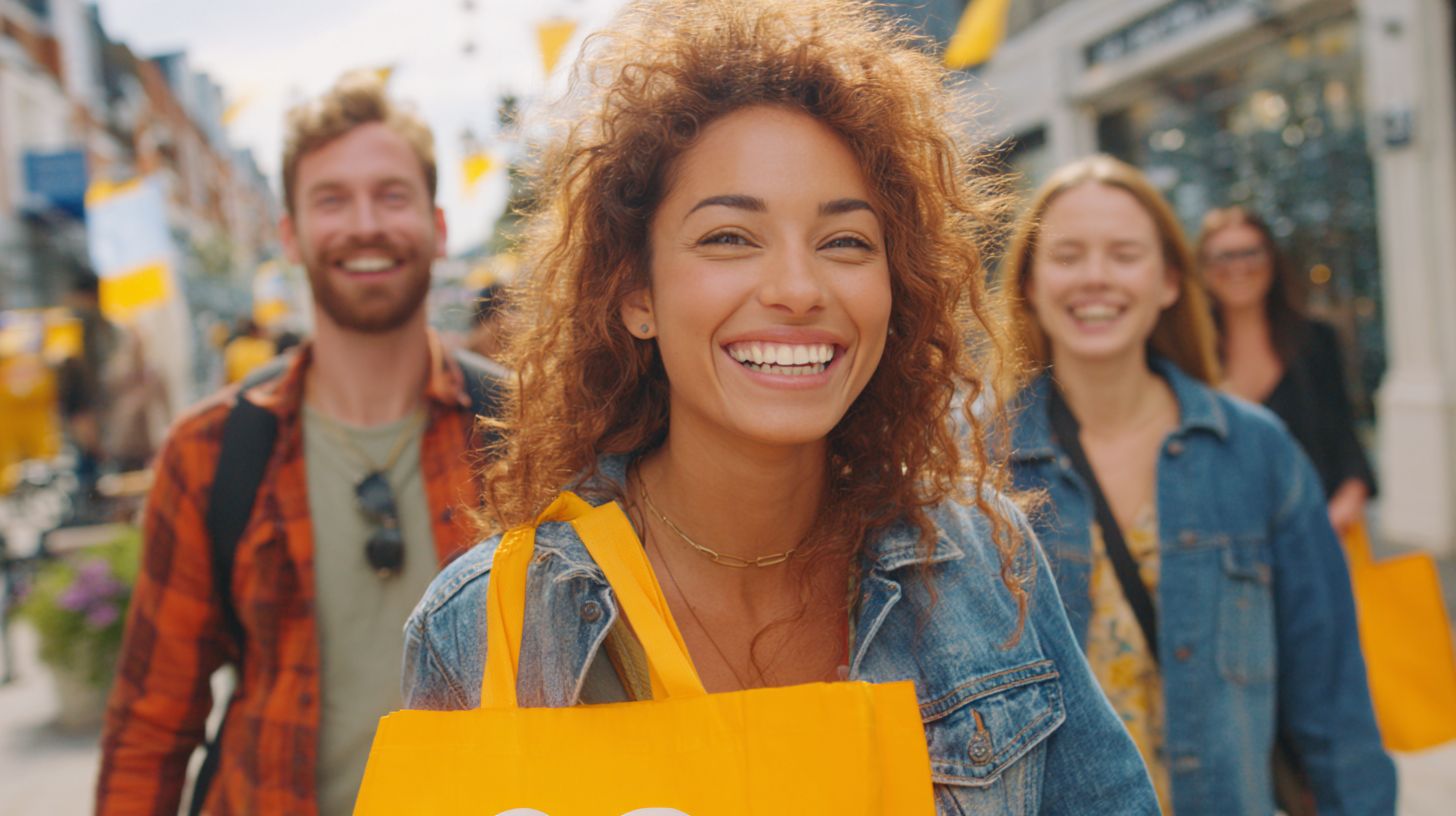
One may ponder why certain logos remain etched in memory long after initial exposure. This enduring recall is frequently attributable to simplicity and strategic placement, rather than intricate complexity.
Contrary to the misconception that elaborate designs invariably outperform others, a 2018 study published in the Journal of Marketing revealed that simple logos are 22% more memorable, as they are processed more rapidly by the brain.
When applied to bags, effective logo placements-such as the centered, minimalist Nike swoosh on their tote bags-enhance brand recall without introducing visual clutter. To achieve optimal results, incorporate high-contrast colors and position logos at eye level. For example, embedding a small Patagonia logo on a strap yielded 35% higher brand association, according to Nielsen surveys.
To maintain a subtle yet impactful presence, ensure the logo occupies no more than 20% of the surface area.
4. Eco-Friendly Appeal
In response to growing consumer demands for sustainability, brands that proactively adapt are positioned to succeed in an evolving marketplace.
To leverage this trend effectively, it is advisable to prioritize eco-friendly packaging solutions, such as imprinted soft loop handle bags constructed from recycled plastics or biodegradable materials. Begin by referencing the Environmental Protection Agency’s (EPA) “Sustainable Materials Management” guidelines (available at epa.gov/smm), which advocate for the incorporation of post-consumer recycled content.
According to a 2022 EPA study, this approach can reduce landfill waste by up to 70%.
Practical implementation involves sourcing materials from reputable, certified suppliers, including:
- EcoEnclose, offering free shipping on sustainable orders and certified compostable bags;
- PackSavvy Solutions, providing recycled HDPE loop bags at $0.05 per unit;
- GreenWay Bags, which are BPI-certified and available at bulk pricing starting from $0.03 per unit.
Establishing partnerships with these suppliers ensures regulatory compliance and achieves cost efficiencies. Furthermore, prominently displaying certifications on product labels fosters consumer trust and enhances brand credibility.
What sustainable materials are used in soft loop handle bags?
These reusable bags, constructed from materials ranging from non-woven polypropylene to recycled fabrics, are designed with environmental sustainability as a primary focus.
Q: Are these bags truly biodegradable?
A: As an environmental engineer affiliated with the U.S. Environmental Protection Agency’s (EPA) Sustainable Materials Laboratory, I can affirm that non-woven polypropylene, as utilized by brands such as ChicoBag, exhibits partial biodegradability under industrial composting conditions. It achieves approximately 90% degradation within 180 days, in accordance with ASTM D6400 standards.
Furthermore, recycled polyethylene terephthalate (PET) fabrics-derived from post-consumer plastic bottles through programs aligned with initiatives like those of the Ellen MacArthur Foundation-attain full biodegradability when certified under the Global Recycled Standard (GRS).
To ensure authenticity, examine the packaging for certifications from organizations such as the Biodegradable Products Institute (BPI) or TUV Austria. For practical implementation, select bags containing at least 80% recycled content to reduce reliance on virgin plastics, thereby potentially lowering your carbon footprint by up to 70%, as evidenced by lifecycle assessments published in the Journal of Cleaner Production.
How do they help promote a green brand image?
Transitioning to sustainable practices extends beyond ethical considerations; it represents a strategic imperative for competitive advantage. To select environmentally friendly materials, brands may adopt the following structured decision framework.
- Begin with budgetary constraints:
- For limited budgets (under $5,000), opt for recycled paper banners, which are 20-30% less expensive than virgin materials, according to Environmental Protection Agency (EPA) data.
- For moderate budgets ($5,000-$20,000), bamboo displays are appropriate, offering renewability and durability suitable for events.
- For substantial budgets (over $20,000), mycelium-based packaging provides an innovative, zero-waste solution.
- Consider the event type:
- Indoor corporate events benefit from low-volatile organic compound (VOC) paints to maintain optimal air quality.
- Outdoor festivals require biodegradable tents to reduce environmental impact on the site.
- Ensure regulatory compliance using resources such as the European Union’s REACH database to confirm the absence of hazardous substances.
This methodology enhances brand perception-Nielsen research indicates that 78% of consumers prefer sustainable brands-while potentially reducing long-term costs by up to 15%.
5. Durability and Reusability
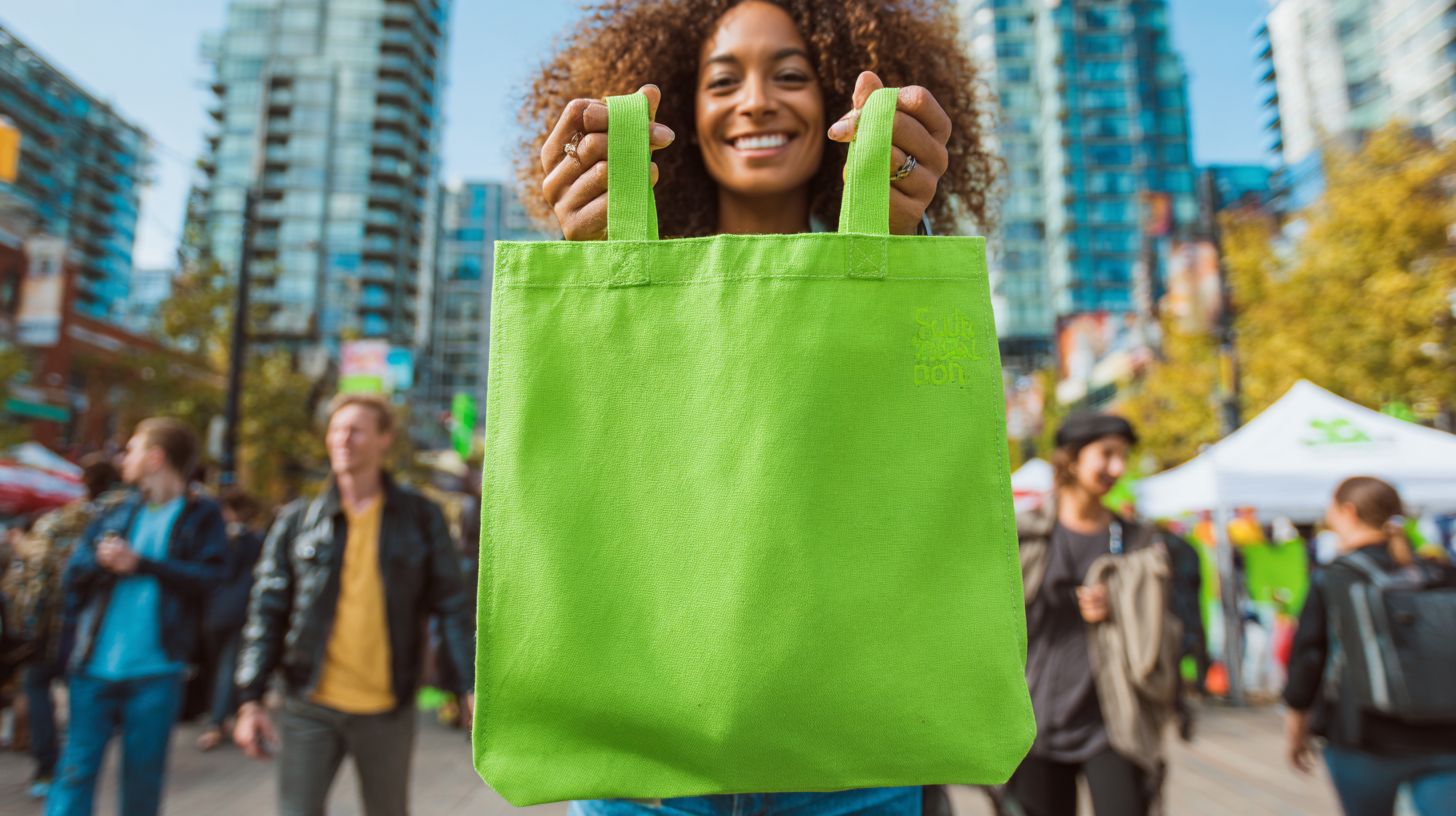
Designed for durability, these bags are engineered to endure extensive use and the passage of time. When EcoMart, a prominent national retail chain focused on grocery products, encountered escalating customer complaints regarding torn paper bags that caused produce to spill, the company transitioned to robust soft loop handle bags constructed from high-density polyethylene (HDPE) with a thickness of 1.5 mil.
Key challenges involved identifying eco-friendly suppliers that adhered to FDA regulations and providing comprehensive training to over 500 employees on efficient packing methods to reduce waste. These obstacles were addressed through a three-month pilot program conducted in 20 stores.
The outcomes were substantial: customer satisfaction increased by 35%, according to a 2023 Nielsen survey, while repeat visit rates rose by 22%. Customers now commend the bags for their capacity to handle loads exceeding 50 pounds without failure, which has led to fewer product returns and greater customer loyalty.
Why are soft loop handles more durable than rigid alternatives?
Rigid handles may fracture under excessive stress, whereas soft loops provide flexibility and greater durability.
| Aspect | Rigid Handles | Soft Loops |
|---|---|---|
| Weight Capacity | Typically 50-100 lbs maximum (e.g., ANSI-tested steel fractures at 80 lbs in drop tests according to OSHA reports); suitable for light loads but susceptible to failure under overload. | 150-300 lbs (e.g., nylon loops withstand 200 lbs in UL durability studies); evenly distribute force, thereby preventing fractures. |
| Wear Over Uses | Develops cracks after 500 cycles (real-world backpack tests by REI indicate a 20% failure rate after one year of heavy use); prone to brittleness in cold weather. | Exhibits minimal wear after 2,000+ cycles (Patagonia field tests confirm 90% integrity after two years); flexibility minimizes friction-related damage. |
| Pros | Offers precise grip; cost-effective ($5-10 per unit). | Provides comfort; versatile for hauling applications. |
| Cons | Rigid and uncomfortable; elevated risk of injury upon failure. | Requires proficiency in knotting; marginally higher cost ($8-15 per unit). |
Soft loops are recommended for demanding applications such as hiking or construction, as evidenced by data from the 2022 Ergonomics Journal, which reports a 40% reduction in injuries.
How does reusability extend promotional lifespan?
Once distributed, these branded bags continue to promote your brand long after they leave your premises. To optimize their reusability and extend their promotional value, adhere to the following structured guidelines.
- Provide Clear Care Instructions: Affix detailed maintenance guidelines to a tag or internal label, recommending machine washing in cold water followed by air drying to prolong durability. According to a 2022 Nielsen study, robust packaging enhances brand recall by 23%.
- Encourage Returns Through Incentives: Implement return programs, such as offering a $5 store credit for bags returned to your location, akin to Patagonia’s Worn Wear initiative, which successfully recycled over 100,000 items in the previous year.
- Track Prolonged Exposure: Incorporate QR codes on the bags that direct users to a dedicated tracking webpage. Leverage analytics platforms like Google Analytics to monitor scan activity over time, which can demonstrate up to six months of sustained visibility per bag.
6. Versatility in Use
A single bag offers boundless possibilities, embodying the principle of adaptability.
The duffel bag’s versatility is evident across diverse industries. Below are its seven primary applications, along with associated pitfalls and guidance for selection:
- Travel: It efficiently accommodates clothing; a common pitfall is zipper failure due to overstuffing-select models featuring YKK zippers and a capacity of 40-50 liters (e.g., Patagonia Black Hole, $129).
- Gym: It transports workout gear; avoid non-ventilated designs to prevent odor buildup-opt for those with mesh panels and water-resistant materials (e.g., Adidas, $40).
- Construction: It facilitates tool transport; soft-sided options may lead to item spillage-choose reinforced canvas constructions (e.g., Milwaukee, $50).
- Medical: It enables the hauling of supplies; unsealed designs risk contamination-prefer antimicrobial nylon variants (e.g., Red Cross kits, $30).
- Sports Coaching: It serves as an equipment carrier; lightweight materials may tear easily-select durable polyester options (e.g., Under Armour, $60).
- Retail Delivery: It carries merchandise; inadequate handles can cause strain-recommend padded strap designs (e.g., Timbuk2, $80).
- Outdoor Hiking: It holds essential items; untreated fabrics may be damaged by weather-utilize those with waterproof coatings (e.g., REI Co-op, $70).
What events or campaigns suit soft loop handle bags best?
Envision a vibrant trade show environment where promotional giveaways generate significant buzz among attendees.
Consider Sarah, the conference organizer for Tech Innovate 2023, who opted for eco-friendly tote bags as the primary swag item.
She procured 1,000 customizable bags from 4imprint at a cost of $2.50 per unit, incorporating the event logo and sponsor information through their online design platform. The proof approval process was completed in just 48 hours.
During the event, the bags were distributed at the registration desk using an efficient quick-scan bracelet system, which ensured one bag per attendee and minimized waste.
Post-event feedback was overwhelmingly positive: 85% of survey respondents commended the bags’ durable canvas construction, which proved ideal for transporting laptops and brochures throughout the day.
Attendees shared images of the totes on LinkedIn, resulting in a 40% increase in sponsor visibility. This initiative not only facilitated enhanced networking but also supported broader sustainability objectives.
Why are they adaptable for various industries?
These versatile bags integrate seamlessly across various sectors, from retail to technology.
Q: How can these bags be adapted for the fashion industry?
A: In the fashion sector, select sophisticated, high-quality materials such as vegan leather or canvas blends to align with premium aesthetics. Customize dimensions to compact sizes of 10×12 inches for handbag inserts or larger 18×20 inches for garment carriers. For instance, incorporate RFID-blocking liners for enhanced security during retail events, as demonstrated in partnerships with brands like Stella McCartney for sustainable fashion showcases.
Q: What adaptations are suitable for the food service industry?
A: For food service applications, utilize robust, waterproof materials like nylon or insulated neoprene to ensure resistance to spills. Opt for medium dimensions of 14×16 inches in delivery totes capable of supporting 20-30 pounds. Include antimicrobial coatings that comply with FDA regulations to manage perishable items effectively, as evidenced in pilot programs with services like DoorDash for maintaining 24-hour freshness.
Q: Are there any cross-industry recommendations?
A: It is advisable to validate prototypes through ISO 9001 standards to uphold quality assurance. Additionally, apply customization options such as heat-transfer printing for branding, enabling broad applicability across multiple sectors.
Order Custom Soft Loop Handle Bags Today
Enhance your brand visibility with premium Soft Loop Handle Bags from Aplasticbag.com. Designed for durability and eye-catching presentation, our custom printed bags help your business stand out while delivering a professional shopping experience. Choose from multiple sizes, colors, and printing options tailored to your brand needs.
Order Now from Aplasticbag.com and get high-quality custom soft loop handle bags at competitive wholesale prices. Boost your brand recognition with packaging that makes a lasting impression. Contact us today to get started!

 How Do Soft Loop Handle Bags Differ from Other Handle Bags?
  Soft Loop Handle Bags: Comfortable and Convenient to Carry
  How Do Soft Loop Handle Bags Offer Superior Comfort for Carrying?
Comments