
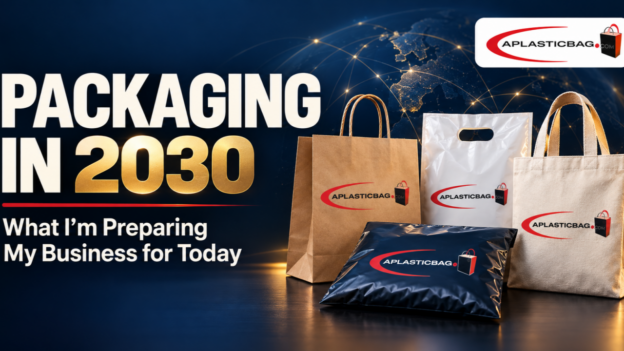
When I think about packaging in 2030, I picture a business owner making a decision.
They need packaging that protects their product, represents their brand, fits their budget, and arrives when promised. They also want to understand the materials they are choosing and what happens to that packaging after use.
The options may change between now and 2030. Those needs will remain central.
As the CEO of APlasticBag.com, I see my responsibility as preparing our business to answer those questions better. That means looking beyond the next order and considering the capabilities, relationships, and knowledge we will need in the years ahead.
I believe the future of packaging will reward businesses that combine innovation with practical judgment. Here is where I want to focus our preparation.
Making sustainability easier to understand
Sustainability is one of the most important conversations in packaging. It can also be one of the most confusing.
A customer may ask for an “eco-friendly bag,” but that request can mean several things: less material, recycled content, repeated use, or access to recycling after disposal.
Before recommending a product, we need to understand what the customer wants to achieve.
The Federal Trade Commission’s Green Guides advise businesses to qualify recyclable claims when appropriate recycling facilities are not available to at least 60% of consumers or communities where the product is sold.
That matters because a material’s ability to be recycled does not automatically mean the customer has somewhere to recycle it.
Looking toward 2030, I want our sustainability conversations to become more specific. We should be able to explain material composition, substantiate recycled content claims, and provide appropriate guidance about reuse and disposal.
We also need to consider performance. Reducing material is useful when the package still protects the product. A reusable bag makes more sense when its construction and design encourage customers to use it repeatedly.
For me, progress begins with helping customers make informed choices they can explain confidently to their own customers.
Using AI to improve decisions and communication
I see considerable potential for AI in the early stages of packaging design.
A business owner with a rough idea could explore different layouts, colors, and campaign concepts before committing to a direction.
Our team could use those concepts to understand the customer’s preferences and develop a clearer design brief.
That could make customization easier, especially for businesses without an in-house creative team.
But a compelling image is only the beginning.
The artwork still needs to suit the printing process. Dimensions need to match the product. Materials, handles, closures, and finishes need to work together.
My priority is to use AI where it helps us explore ideas and communicate clearly, while keeping experienced people responsible for production decisions and final approvals.
By 2030, I want technology to give our team more time to solve customer problems. Faster work has value when it also leads to a better result.
Helping businesses order with greater confidence

Packaging quantity is a business decision with consequences beyond the price per unit.
Imagine a retailer ordering custom bags for a holiday promotion. A larger order may offer attractive pricing, but the remaining bags could become difficult to use once the campaign ends.
A design that works across several seasons may be more valuable than one tied to a single event. A phased ordering plan may suit some customers, where production requirements and lead times allow it.
These are conversations I want us to have earlier.
We should understand expected demand, storage space, campaign dates, and how quickly a customer may need to reorder. Minimum quantities and production economics should be clear before the customer invests time in a design.
As I look toward 2030, I want quantity planning to become a stronger part of the service we provide. The right order is one that makes sense for the customer’s business.
Designing for the entire customer experience
Packaging becomes part of the experience as soon as a customer touches it.
Does the bag feel comfortable to carry? Is the mailer easy to open? Does the package fit the product? Is the branding clear? Can the customer use it again?
Those details influence how the purchase feels.
I believe more brands should consider packaging alongside their store experience, website, and customer service. Each contributes to the impression the business leaves behind.
That does not require an elaborate design. A well-proportioned bag with reliable handles and clear printing can communicate care and professionalism.
Digital features should serve the same purpose. A QR code could lead to product care instructions, reorder information, or a useful brand story. The destination needs to give the customer a reason to scan it.
For 2030, my focus is on packaging that earns its place in the customer experience through usefulness, appearance, and dependable performance.
Preparing for changing market requirements
Businesses selling across borders need to understand the packaging expectations of each market they serve.
The European Commission’s Packaging and Packaging Waste Regulation establishes a framework for greater recyclability, recycled content, waste reduction, and reuse, with major milestones tied to 2030.
These requirements concern the EU market. For a packaging leader, they also provide a reason to pay attention to international developments and ask how customers’ future needs may change.
I want our preparation to begin with better supplier information and documentation.
We need to understand the materials we offer, the evidence behind product claims, and when a customer’s application or destination requires additional review.
A customer expanding into a new market should be able to have a useful conversation with their packaging partner before placing an order.
That requires continuous learning and the willingness to ask questions before making promises.
Making reliability a leadership priority

When people discuss the future of packaging, the conversation often centers on materials, automation, and design.
I also think about the customer waiting for a quote, reviewing a proof, or checking whether an order will arrive before a store opening.
Reliability deserves a place in every innovation strategy.
A good ordering experience should make specifications, approvals, production timing, and delivery expectations easy to understand. If something changes, the customer needs timely information so they can adjust their plans.
I want us to measure progress by how confidently customers can work with us.
New tools can improve visibility and reduce administrative work. Clear communication and accountability still depend on the people leading the business.
The preparation starts with today’s choices
2030 is close enough to influence the decisions we make now.
The materials we evaluate, the supplier relationships we build, the information we maintain, and the tools we adopt will shape our ability to serve customers in the years ahead.
We do not need to predict every change to prepare thoughtfully.
We can ask better questions. We can make product information clearer. We can test new ideas carefully and listen when customers tell us what is difficult about buying packaging.
My vision for APlasticBag.com is to make choosing custom packaging easier, more informed, and more dependable.
That is the business I want to build toward 2030 one that helps customers move forward with confidence.
If you lead a brand or retail business, what would you most like your packaging partner to do better by 2030?

 Custom Packaging Trends 2027: 10 Trends U.S. Businesses Should Know
 10 Benefits of Using Custom Printed Packaging for eCommerce Brands
 Wholesale Packaging Supplies: How Businesses Save Money with Bulk Orders

Comments