

Choosing the right retail packaging can influence more than how customers carry their purchases. Custom plastic shopping bags offer businesses a practical combination of durability, customization, and convenience, while paper packaging appeals to brands looking for a traditional, paper-based presentation. For U.S. retailers, restaurants, boutiques, pharmacies, grocery stores, and other businesses, the right choice depends on cost, branding goals, product weight, customer experience, and local packaging requirements.
Plastic and paper bags both have an important place in retail packaging. Neither option is automatically the best for every business. A boutique selling lightweight apparel may have different needs from a grocery store handling heavier products. Likewise, a premium retailer may prioritize presentation, while a high-volume business may focus more heavily on cost and carrying performance.
Understanding the differences can help businesses choose packaging that supports daily operations while presenting a consistent brand image.
Cost Comparison: Plastic vs Paper Packaging
Cost is often one of the first considerations when businesses order packaging in bulk.
Plastic bags can be attractive for high-volume businesses because they generally require less material to provide a lightweight yet durable carrying solution. Their flexibility can also make storage and transportation easier. When purchased in larger quantities, businesses can evaluate the overall cost per bag and select specifications based on their expected usage.
Paper bags can have a higher material and production cost depending on paper weight, construction, printing, handles, and finishing. Premium paper packaging may also require additional design elements to achieve a particular appearance.
However, price should not be evaluated by the bag alone. Businesses should consider the total value of the packaging, including:
- Quantity required
- Bag size and capacity
- Material thickness
- Printing requirements
- Handle style
- Storage requirements
- Product weight
- Expected reuse
- Shipping and fulfillment costs
For businesses ordering thousands of bags, even a small difference in unit cost can influence the overall packaging budget.
Branding: Which Packaging Creates More Impact?
Packaging can become part of the customer’s experience. A plain bag simply performs a carrying function, while a customized bag can communicate a company’s visual identity.
Plastic bags offer a broad surface for logos, brand names, graphics, promotional messaging, and other design elements. Businesses can select colors and printing approaches that complement their existing branding.
Paper packaging also provides an excellent printing surface and can create a more traditional retail appearance. It is particularly popular among boutiques, gift shops, specialty retailers, and businesses that want packaging to reinforce a crafted or premium visual identity.
The key question is not simply whether plastic or paper offers better branding. Instead, businesses should consider which material better matches their brand personality and customer expectations.
A modern apparel retailer, for example, might use a brightly printed plastic bag to create a recognizable shopping experience. A specialty gift store may prefer a structured paper bag that emphasizes presentation.
Convenience and Everyday Use
Convenience becomes particularly important when packaging is used hundreds or thousands of times each week.
Plastic bags are lightweight, flexible, and generally easy to store. They can handle a variety of everyday retail products without adding substantial weight to the customer’s purchase.
Their flexibility can also be useful when stores have varying product sizes. A single bag style may accommodate different lightweight merchandise categories.
Paper bags offer a more structured shape, which can help certain products remain upright. However, they may take up more storage space depending on their construction and handle style.
For busy retailers, packaging that is quick to distribute, easy to store, and suitable for different products can simplify daily operations.
Durability and Carrying Performance
A shopping bag needs to perform its basic job: carrying merchandise from the store to the customer’s destination.
Plastic packaging is valued for its flexibility and resistance to tearing under many everyday retail conditions. The appropriate thickness and construction should be selected according to the intended application.
Paper bags can also provide strong carrying performance when manufactured with suitable paper weight, reinforced construction, and appropriate handles. However, exposure to moisture can be an important consideration for some applications.
Businesses should therefore evaluate the products they sell before selecting a bag. Lightweight clothing, packaged goods, pharmacy items, books, gifts, and food products may all require different packaging specifications.
Storage and Inventory Management
Packaging does not only occupy space at the checkout counter. Large quantities need to be stored before they are used.
Plastic bags can be compressed and stored efficiently, making them convenient for businesses with limited backroom space. Their lightweight construction can also simplify internal movement and handling.
Paper bags generally have a more structured shape. Depending on the design, they may require more storage volume.
For businesses ordering in bulk, it is worth considering how many bags can be stored comfortably and how frequently new inventory needs to be ordered.
Customization Options for Retail Businesses
Customization allows businesses to choose packaging according to their products, customers, and brand identity.
Businesses can consider different:
- Bag dimensions
- Material options
- Thicknesses
- Colors
- Printing designs
- Handle styles
- Finishing options
- Quantity levels
For companies that want packaging to function as a form of brand exposure, customized printing can make a standard shopping bag more recognizable.
This is particularly useful for businesses where customers carry their purchases through shopping centers, streets, events, offices, or other public spaces.
Custom Plastic Bags for Business: When Do They Make Sense?
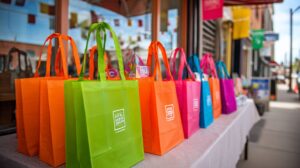
For many retailers, custom plastic bags for business can provide a practical balance between customization and everyday usability.
They may be suitable for clothing stores, convenience retailers, pharmacies, grocery-related businesses, salons, promotional events, specialty stores, and other applications where customers need a lightweight carrying solution.
Businesses should select the size and construction based on the merchandise being packaged rather than choosing a one-size-fits-all option.
For example, a small boutique may need compact bags for accessories, while an apparel retailer may require larger bags for folded clothing. A pharmacy may prioritize easy handling and appropriate dimensions for boxed products.
Die Cut Handle Bags With Logo
Die cut handle bags with logo are a popular option for businesses looking for a simple, practical bag design with built-in branding space.
The handle is integrated into the bag itself, creating a streamlined appearance. A printed logo or business message can turn the bag into a recognizable part of the customer experience.
These bags can work well for retail stores, trade events, promotional campaigns, and businesses that want a straightforward packaging format.
Merchandise Bags at Wholesale
Merchandise Bags at Wholesale are useful for businesses that distribute packaging in high volumes.
Wholesale purchasing can help retailers maintain consistent packaging inventory while planning around regular product demand. Instead of placing frequent small orders, businesses can evaluate their expected usage and select quantities that align with their operations.
Wholesale merchandise packaging can be especially relevant for retailers with multiple locations, seasonal promotions, recurring customer traffic, or large-scale events.
Businesses should compare bag specifications as carefully as unit pricing. A lower-priced bag may not provide the right capacity or carrying performance for a particular application.
Custom Soft Loop Handle Bags
Custom Soft Loop Handle Bags combine a flexible handle style with customized branding. The soft loop design can provide a different feel from traditional die cut handles and may be suitable for retailers seeking a more distinctive presentation.
These bags can be customized to reflect a business’s visual identity and are particularly useful when customer experience and brand recognition are important considerations.
For fashion retailers, boutiques, promotional businesses, and specialty stores, the handle itself can become part of the packaging design.
Case Study Example: A Boutique Retailer Comparing Packaging Options
Consider a fictional U.S. clothing boutique that sells apparel and accessories from a physical storefront.
The business previously used plain paper bags but noticed that storage space became difficult to manage during seasonal sales. The retailer also wanted packaging that could accommodate different clothing purchases without requiring several bag formats.
The business evaluated customized plastic packaging with printed branding.
Instead of selecting the cheapest available option, the retailer reviewed its average order size, product dimensions, storage capacity, and monthly bag usage. It selected two primary bag sizes and incorporated its logo into the design.
The result was a more consistent packaging system. Employees could quickly select the appropriate bag, the business had recognizable branded packaging, and inventory could be organized around predictable bag sizes.
The lesson is simple: packaging decisions should be based on actual business requirements rather than material preference alone.
Custom Plastic Bags Partner in USA
Finding the right Custom Plastic Bags Partner in USA can make the ordering process easier for businesses that require customized packaging at scale.
A reliable packaging partner should be able to discuss bag dimensions, material specifications, printing requirements, handle styles, order quantities, and intended applications.
For U.S. businesses, working with a supplier familiar with domestic retail requirements can also simplify communication and ordering. Businesses should clearly define their packaging requirements before requesting pricing so that quotes can be compared accurately.
A good purchasing process starts with questions such as:
What products will the bags carry?
What bag sizes are needed?
How many bags are required?
Will the bags feature one-color or multi-color branding?
Which handle style is most suitable?
How frequently will the business reorder?
Answering these questions can make it easier to identify the appropriate packaging configuration.
Which Is Better for Your Business: Plastic or Paper?

There is no universal answer.
Choose plastic packaging when your business prioritizes lightweight handling, flexible storage, durability, and customizable retail packaging.
Choose paper packaging when your business prioritizes a structured appearance, paper-based presentation, or a particular brand aesthetic.
Some businesses may even use both. For example, a retailer could use customized plastic bags for everyday purchases while reserving premium paper bags for special orders, gifts, or higher-value purchases.
The best approach is to match the packaging format with the product, customer experience, operating environment, and brand strategy.
Packaging Should Work as Hard as Your Business
A shopping bag is a small part of a retail operation, but its impact can extend beyond the checkout counter. It needs to protect and carry merchandise while supporting the way customers experience a brand.
Plastic and paper packaging each offer different advantages. Plastic can provide flexibility, lightweight handling, efficient storage, and extensive customization possibilities. Paper can offer structure and a distinctive retail presentation.
For businesses considering customized packaging, the most important step is to define the actual application first. Once product type, size, quantity, branding, handle style, and budget are established, selecting the right packaging becomes much easier.
Aplasticbag helps businesses explore customized plastic packaging solutions designed around their specific retail and promotional requirements.
Frequently Asked Questions
Q: Are custom plastic shopping bags cheaper than paper bags?
The cost depends on bag size, material, thickness, printing, handle style, quantity, and other specifications. For high-volume orders, businesses should compare the total cost per bag based on their actual requirements.
Q: Are plastic bags good for retail branding?
Yes. Customized plastic bags can feature logos, colors, graphics, and brand messaging, allowing businesses to create recognizable packaging that customers may carry outside the store.
Q: Which is more durable, plastic or paper packaging?
Durability depends on the material specification and bag construction. Plastic offers flexibility and can perform well for many everyday retail applications, while properly constructed paper bags can also provide strong carrying capacity.
Q: What businesses use custom plastic bags?
Retail stores, boutiques, pharmacies, grocery-related businesses, salons, convenience stores, specialty retailers, promotional companies, and event businesses can use customized plastic bags for different applications.
Q: What are die cut handle bags used for?
Die cut handle bags are commonly used for retail merchandise, promotional distribution, events, and everyday shopping applications. Their integrated handles provide a simple and practical carrying format.
Q: Can businesses order merchandise bags in wholesale quantities?
Yes. Wholesale ordering can be useful for businesses with consistent or high packaging demand. Larger quantities can help maintain inventory and support recurring retail operations.
Q: Are custom soft loop handle bags suitable for branding?
Yes. Soft loop handle bags can be customized with business branding and can provide a distinctive alternative to standard handle styles.
Q: How should a business choose between plastic and paper bags?
Consider product weight, bag size, branding requirements, storage space, customer experience, expected order volume, budget, and applicable local packaging requirements. These factors can help determine which option is most suitable.
Q: What should I ask a custom bag supplier before ordering?
Ask about available sizes, material specifications, thickness, handle styles, printing options, minimum quantities, production timelines, shipping, and pricing. Providing your intended application will also help the supplier recommend an appropriate configuration.
Ready to Upgrade Your Retail Packaging?
Your packaging should do more than carry merchandise, it should support your brand, simplify daily operations, and deliver the convenience your customers expect.
Choose the right size, style, and customization for your business with Aplasticbag. Request a quote today and start planning your next bulk packaging order.

 Custom Plastic Shopping Bags: Get Better Deals Without Sacrificing Quality
  Wholesale Plastic Shopping Bags: A Complete Buying Guide for Retail Businesses
  Paper Bags: The Go-To Choice for Eco-Friendly Packaging
Comments