
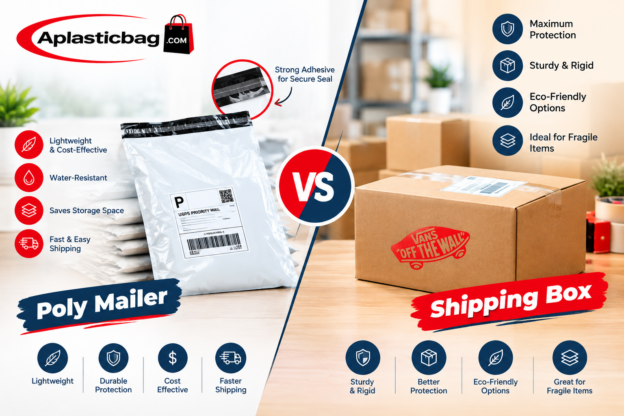
Poly mailers vs. shipping boxes is an important cost comparison for US ecommerce businesses looking to reduce shipping expenses without compromising product protection. Poly mailers generally cost less for lightweight, non-fragile products because they use less packaging material and take up less space. Shipping boxes are often worth the extra cost for fragile, heavy, bulky, or shape-sensitive items.
Poly Mailer vs. Shipping Box: What’s the Difference?
Poly mailers are lightweight plastic mailing bags designed for shipping products that do not require rigid protection. They are commonly used for clothing, accessories, soft goods, and other flexible products. Shipping boxes provide a rigid structure that helps protect items from crushing, impacts, and pressure during transit.
The better option depends on your product, shipping method, package dimensions, and the level of protection required. A lower packaging cost does not always mean a lower total shipping cost, so businesses should compare both options using their actual shipment details.
Poly Mailers vs. Shipping Boxes: Cost Comparison
| Comparison Factor | Poly Mailers | Shipping Boxes |
|---|---|---|
| Packaging cost | Generally lower | Generally higher |
| Packaging weight | Lightweight | Usually heavier |
| Storage space | Compact and easy to store | Requires more storage space |
| Shipping dimensions | Flexible and compact | Rigid dimensions may increase billable weight |
| Product protection | Best for non-fragile, flexible goods | Better for fragile and rigid products |
| Water resistance | Many polyethylene mailers resist moisture | Depends on box material and additional protection |
| Packing materials | Often require little additional material | May require cushioning, fillers, or inserts |
| Branding options | Custom printing, colors, and finishes | Custom printing, graphics, and branded box designs |
| Typical applications | Apparel, textiles, soft accessories | Electronics, glassware, gifts, and structured products |
The main takeaway: Poly mailers are often the economical choice for products that can be shipped safely without a rigid container. Boxes are preferable when the risk of product damage outweighs the additional packaging and shipping expense.
Why Do Poly Mailers Usually Cost Less to Ship?
1. Lower Packaging Weight
Poly mailers use relatively little material, making them a practical choice for lightweight shipments. A soft mailer containing a T-shirt, for example, will generally weigh less than a cardboard box containing the same item, particularly when the box requires inserts or additional cushioning.
Actual postage depends on the packaged shipment’s final weight, dimensions, destination, and carrier service.
2. Smaller Shipping Dimensions
A poly mailer can conform closely to a product’s shape, whereas a shipping box retains its rigid dimensions even when the item inside is small.
This difference matters because some carrier services calculate shipping charges using dimensional weight when a package is relatively large compared with its actual weight.
USPS applies dimensional-weight pricing to qualifying low-density parcels exceeding one cubic foot for specified services. Its published rules explain how dimensional weight is calculated from package dimensions. Other carriers and services have their own pricing rules.
3. Faster Packing and Fulfillment
Poly mailers are often easy to load, seal, label, and dispatch. Businesses shipping hundreds of clothing orders daily may save time by using mailers rather than assembling boxes and adding protective materials.
The actual labor savings depend on the packing workflow, product type, and fulfillment equipment.
4. Lower Storage Requirements
Poly mailers can be stored flat and generally occupy less warehouse space than assembled or bulky cardboard boxes.
For small ecommerce businesses working from limited storage areas, this can improve packing-station organization and reduce the space required for packaging supplies.
When Are Shipping Boxes the Better Choice?
Although mailers are often less expensive, they are not appropriate for every product.
Fragile Products
Glassware, ceramics, delicate electronics, and breakable gifts usually need the structure and cushioning a box can provide. A mailer may leave these items vulnerable to impact or crushing.
Heavy or Rigid Products
Products with sharp edges, hard corners, or substantial weight can puncture or damage an unsuitable mailer. A properly sized box can provide a more stable shipping solution.
Premium Gift Packaging
Some products require a presentation that a soft mailing bag cannot provide. Rigid boxes, inserts, and branded packaging can help maintain the appearance of premium merchandise.
Products That Need Organized Protection
Multiple products shipped together may require compartments, inserts, or cushioning to prevent movement. Boxes offer more flexibility for arranging and separating items.
The goal is to choose the lightest and smallest package that protects the product adequately throughout transit.
Poly Mailer vs. Shipping Box: Example Shipping Costs
Consider a hypothetical US ecommerce business shipping a lightweight apparel item.
| Cost Component | Poly Mailer Shipment | Box Shipment |
|---|---|---|
| Packaging | $0.20 | $0.80 |
| Additional protective materials | $0.00 | $0.20 |
| Postage | $5.50 | $6.25 |
| Total per shipment | $5.70 | $7.25 |
These figures are illustrative examples, not live carrier rates or APlasticBag product quotations.
In this scenario, the mailer saves $1.55 per shipment. Across 1,000 shipments, that would represent $1,550 in potential savings.
However, the result can change depending on package weight, destination, carrier discounts, dimensions, and the protection required. A box may be the better financial decision if it significantly reduces product damage and replacement costs.
For an accurate comparison, weigh and measure both fully packed options, then compare carrier quotes using the same destination and service level.
How to Calculate Your Total Packaging Cost
Businesses should compare more than the price of the packaging itself.
Use this formula:
Total cost per shipment = packaging + postage + protective materials + packing labor + expected damage costs
For example, a mailer that costs less upfront may not be the best option for an item that frequently arrives damaged. Replacements, refunds, customer service, and return shipping can eliminate the initial savings.
Similarly, an oversized box can increase costs when a smaller, suitable package would protect the product just as effectively.
Before making a change, test both packaging types with representative products and review the results across several shipments.
What MOQ and Lead Time Should You Expect?
If your business plans to purchase wholesale or custom printed packaging, minimum order quantity (MOQ) and production time can affect the overall budget.
The ranges below are planning estimates rather than guaranteed supplier terms.
| Packaging Type | Indicative MOQ for Planning | Indicative Lead Time | Best For |
|---|---|---|---|
| Stock poly mailers | Packs of approximately 100–1,000+ | Stock availability and shipping dependent | Small and growing sellers |
| Custom printed poly mailers | Approximately 500–5,000+ | Around 2–6+ weeks | Branded ecommerce shipments |
| Stock shipping boxes | Often sold in bundles or case quantities | Stock availability and shipping dependent | Immediate fulfillment needs |
| Custom printed shipping boxes | Approximately 500–5,000+ | Around 4–10+ weeks | Established brands and premium packaging |
| Large-volume custom packaging | Several thousand units or more | Product-specific; allow additional planning time | High-volume ecommerce operations |
Actual MOQs and lead times vary with dimensions, materials, printing methods, order volume, artwork approval, production schedules, and shipping. Confirm the current requirements for your selected product before committing to a deadline.
Stock packaging may be available sooner than custom packaging because it does not require a new printed production run. Custom orders should be planned early enough to accommodate design approval, manufacturing, and delivery.
Are Wholesale Poly Mailers More Cost-Effective?
For businesses with regular shipping demand, buying poly mailers wholesale can reduce the per-unit packaging cost.
However, ordering in bulk only makes sense when the quantity matches your expected usage. A business shipping 100 orders per month has different inventory needs from a business shipping 5,000 orders per month.
When comparing wholesale options, consider:
- Mailer dimensions and material thickness
- Self-sealing closure
- Moisture resistance
- Tear and puncture resistance
- Printing and branding requirements
- Quantity-based pricing
- Storage capacity
- Reorder availability
Explore wholesale poly mailers to help readers compare bulk purchasing options, and link this phrase to the relevant APlasticBag wholesale product page.
For branded ecommerce packaging, also connect this section to Custom Poly Mailers for Shipping.
How Custom Poly Mailers Help Ecommerce Brands
Custom poly mailers combine practical shipping performance with brand visibility. A business can print its logo, brand colors, messaging, or promotional graphics on the outer surface to create a recognizable delivery experience.
They are especially useful for clothing brands, online boutiques, subscription businesses, and companies shipping non-fragile soft goods.
Before ordering, determine whether your products require opaque packaging, a particular thickness, a tamper-evident closure, or special printing. Make sure the selected mailer fits the product without excessive empty space or unnecessary strain on the seams.
For more ideas on improving packaging efficiency and customer experience, link this section to Ecommerce Packaging Trends 2026.
Shipping Box for Retail Products: What Should Businesses Consider?
Retail shipping boxes remain essential when products need structural support, additional cushioning, or a more substantial presentation.
The right box should accommodate the product and its protective materials without leaving excessive unused space. Oversized boxes can require more filler and may increase shipping costs, depending on the carrier and service.
Businesses should compare box dimensions, board strength, packing requirements, and branding options before choosing a standard or custom design.
For additional information, link readers to Shipping Box for Retails and the relevant retail packaging products on APlasticBag.
Expert Perspective on Choosing the Right Shipping Packaging
APlasticBag staff perspective:
“The most cost-effective packaging choice depends on the product being shipped. Lightweight, flexible products may work well in poly mailers, while fragile or rigid products often need the added protection of a shipping box.”
Another important consideration is the total fulfillment expense:
“Businesses should compare packaging costs alongside postage, packing time, and product protection. Saving a few cents on packaging is worthwhile only when the shipment still reaches the customer in good condition.”
These perspectives reflect the key factors businesses should evaluate when selecting shipping materials. For publication as direct staff quotations, confirm the wording with the relevant APlasticBag team member.
How to Choose Between a Poly Mailer and a Shipping Box
Poly Mailer vs. Shipping Box
Use these practical guidelines when deciding which package to use.
Choose a poly mailer when:
- Your product is lightweight and non-fragile.
- It can safely bend or compress to fit the mailer.
- You want to minimize packaging weight and storage space.
- You need an efficient option for high-volume apparel or soft-goods shipping.
Choose a shipping box when:
- Your product is fragile, rigid, or heavy.
- The item needs cushioning or structural support.
- You are shipping multiple products that need separation.
- Presentation or product protection requires a rigid container.
If you ship different types of products, you may benefit from keeping both packaging options available. This allows your team to choose a suitable package for each order rather than forcing every product into the same format.
Final Verdict: Which Costs Less to Ship?
For lightweight clothing, textiles, and other non-fragile products, poly mailers often provide lower combined packaging and shipping costs. Their low material use, compact storage, and simple packing process can make them particularly attractive for ecommerce businesses.
Shipping boxes are usually the better option for fragile, heavy, rigid, or premium products that need structural protection.
The best choice is not simply the package with the lowest price. It is the one that balances packaging cost, postage, labor, product protection, and customer experience.
Compare your actual shipment dimensions, weights, and carrier rates before switching packaging formats. Even a small per-order saving can make a meaningful difference when your business ships thousands of orders each month.
Get a Free Custom Quote
Ready to Lower Your Packaging Costs?
APlasticBag can help your business explore packaging options for ecommerce orders, retail products, and branded shipping requirements.
Whether you need wholesale poly mailers, custom printed poly mailers, or retail packaging, start with your product dimensions, expected order quantity, material preferences, artwork, and delivery deadline.
Get a Free Custom Quote from APlasticBag to compare suitable packaging options for your business.
Visit APlasticBag.com to explore packaging solutions and discuss your requirements.
Choose packaging that protects your products, supports your brand, and helps control your shipping costs.

 How to Choose the Right Poly Mailer Size Without Overspending
 Why Should You Consider Custom Poly Mailers for Small Business?
 What Are the Best Custom Poly Mailer Designs for Small Businesses?

Comments